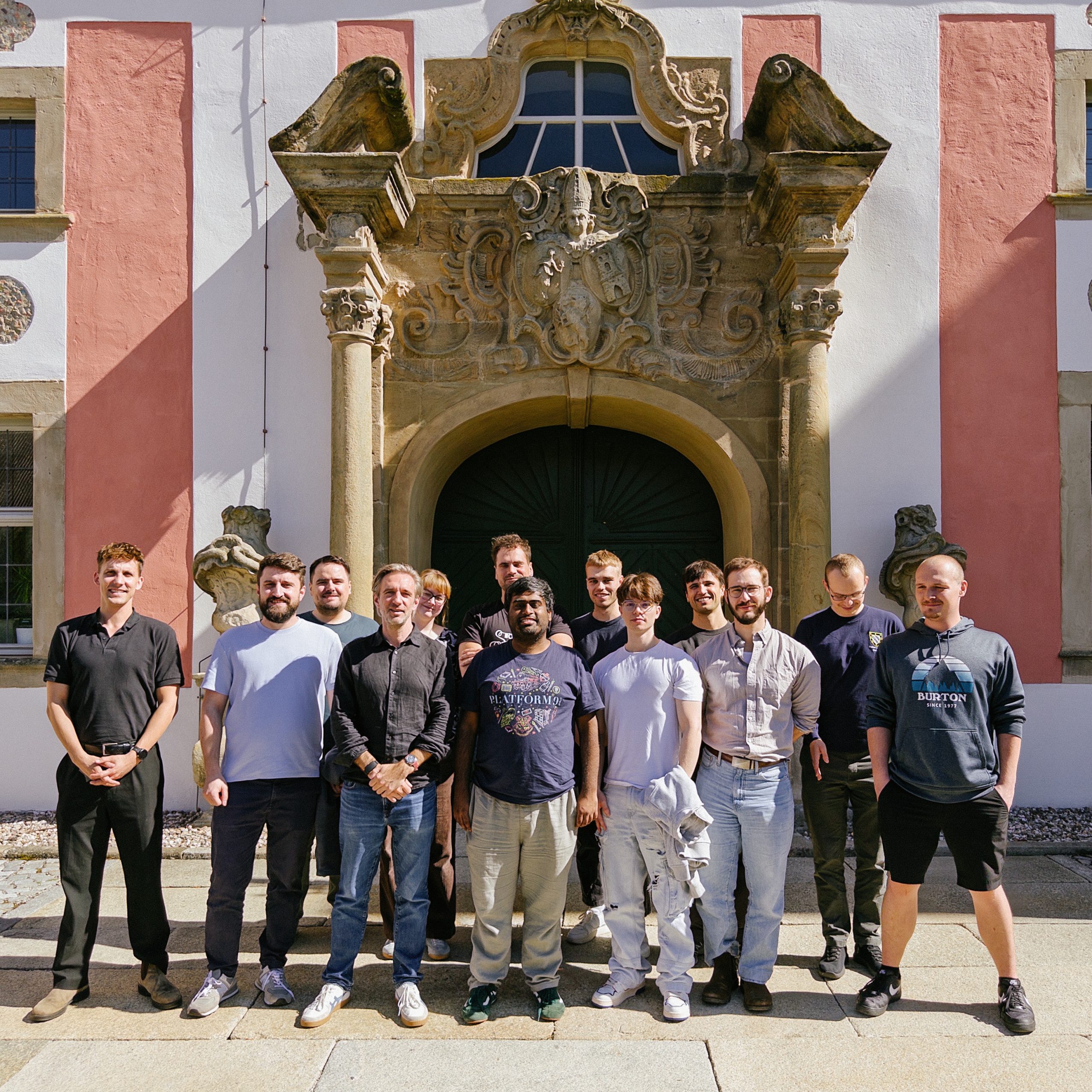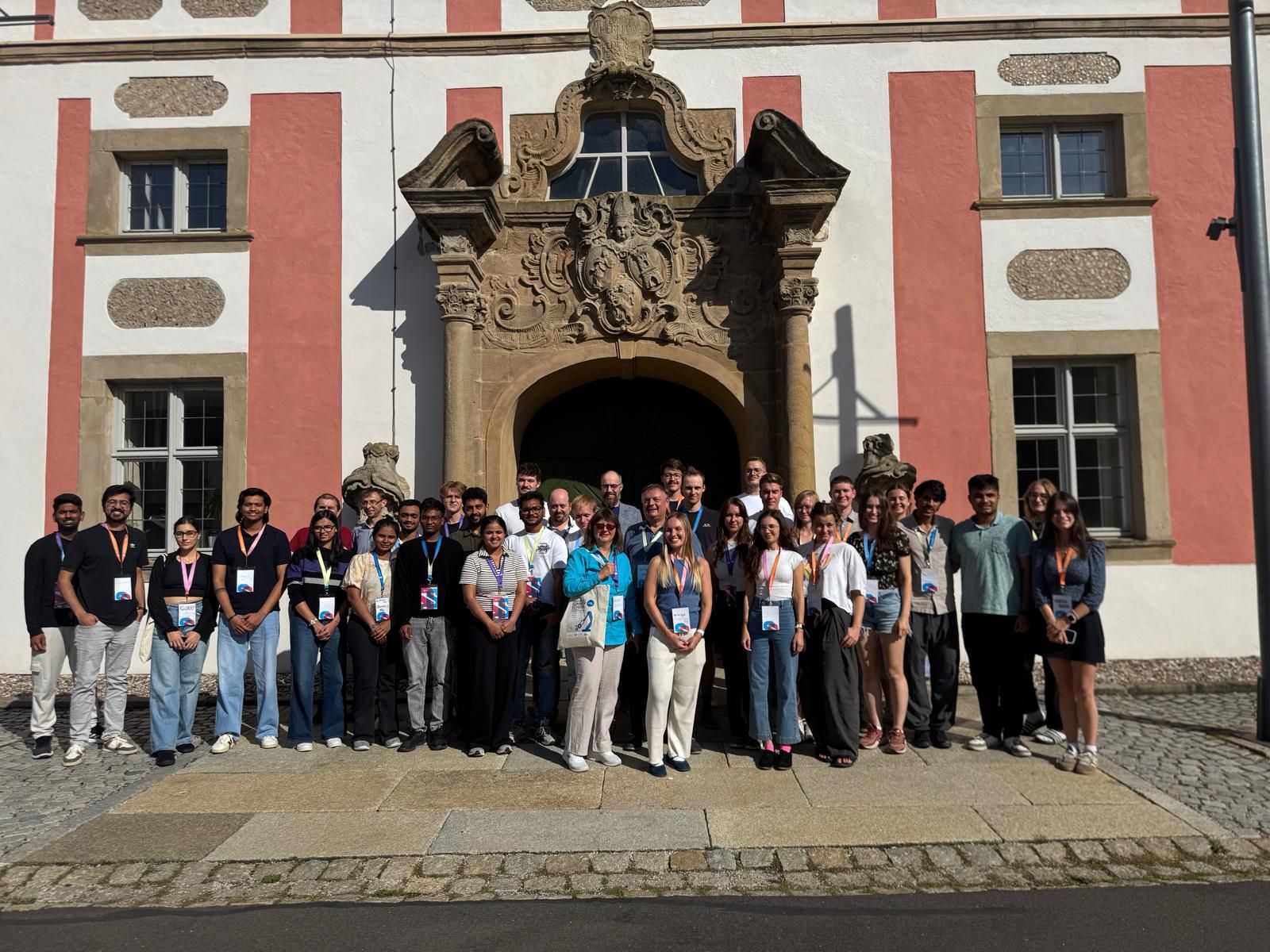
The workshop focuses on recent advances in singularity formation in nonlinear fluid equations and on the growing use of AI-based methods. It brings together researchers working at the intersection of nonlinear partial differential equations (PDEs), especially those arising in fluid dynamics, and the areas of control theory, numerical analysis, and machine learning. The participants include both early-career researchers and a number of more established scholars.
Its aims are to present recent advances, identify key open problems, and foster new collaborations. The event is designed as a focused, retreat-style workshop that prioritizes sustained technical interaction and collaborative problem solving, rather than a traditional conference format.
The fields of nonlinear PDEs, control theory and machine learning are increasingly intertwined [Ber+25]. Nonlinear PDEs continue to uncover mechanisms behind complex phenomena; machine learning has become a powerful framework for uncovering patterns and making efficient predictions from large datasets [PZ25; ECG+24]; and recent developments in control theory are informing machine learning through guarantees of robustness, stability, and interpretability [GZ21; Bid+23; BJ23; Ben+22; Kou25; GZ22; RZ23].
A large part of this interaction concerns nonlinear PDE models arising in fluid dynamics, which encode key physical mechanisms (including transport, vortex stretching, nonlocal interactions, and conservation or dissipation of key quantities) that often interact in delicate ways that can drive extreme events such as shocks, gradient growth, and genuine finite-time singularities. In parallel, control-theoretic perspectives on fluid equations aim to clarify how subtle geometric properties of the Euler and Navier–Stokes dynamics influence stabilizability, controllability, and sensitivity to perturbations, as well as the structural mechanisms that govern the onset or suppression of extreme behaviors [CMS20; CL14].
Understanding the formation of singularities is essential both for identifying the limits of fluid models and for resolving major open problems, including the Millennium Prize Problem for Navier–Stokes or the finite-time singularity formation for Euler (see the recent breakthrough [Elg21] for the case of C1,α data). Recent work [Wan+23; Wan+25a; Wan+25b] has expanded the available tools by introducing AIassisted techniques relying on physics informed neural networks (PINNs) capable of detecting unstable blow-up configurations in several fluid models. Such approaches illuminate potential singularity scenarios and provide some guidance for both numerical exploration and rigorous analysis.
Related developments have emerged in the study of (inviscid) hyperbolic conservation laws, where capturing shocks and other discontinuities requires formulations compatible with entropy conditions. In this setting, recent variants of PINNs (called weak PINNs) have been developed, in which the training residual is imposed in an entropy-weak formulation rather than pointwise, ensuring consistency with entropy inequalities and permitting stable approximation of discontinuous solutions [DMM24; CG24]. A major open direction concerns the transition from high-accuracy computational evidence to rigorous existence of solutions manifesting the same phenomena. For certain fluid models, recent work has introduced a promising strategy that combines conditional regularity results with conditional a posterior error bounds [HG25; BGT25], offering a mechanism for validating numerical observations at the analytical 1/3 level. Applying and adapting these ideas to numerical approximations of singularity formation—where instability and stiffness are intrinsic—poses a deep and unresolved problem.
The developments surveyed above highlight a common set of challenges: singularity formation in fluid models depends on subtle analytical structures that are difficult to study numerically, and is increasingly explored through AI-based tools whose relation to the underlying PDE mechanisms remains an open question. The unifying goal of the workshop is therefore to articulate how these perspectives fit together.
Please note: This is just an information regarding events taking place at SSC; public attendance is therefore not possible due to the character of the retreat.