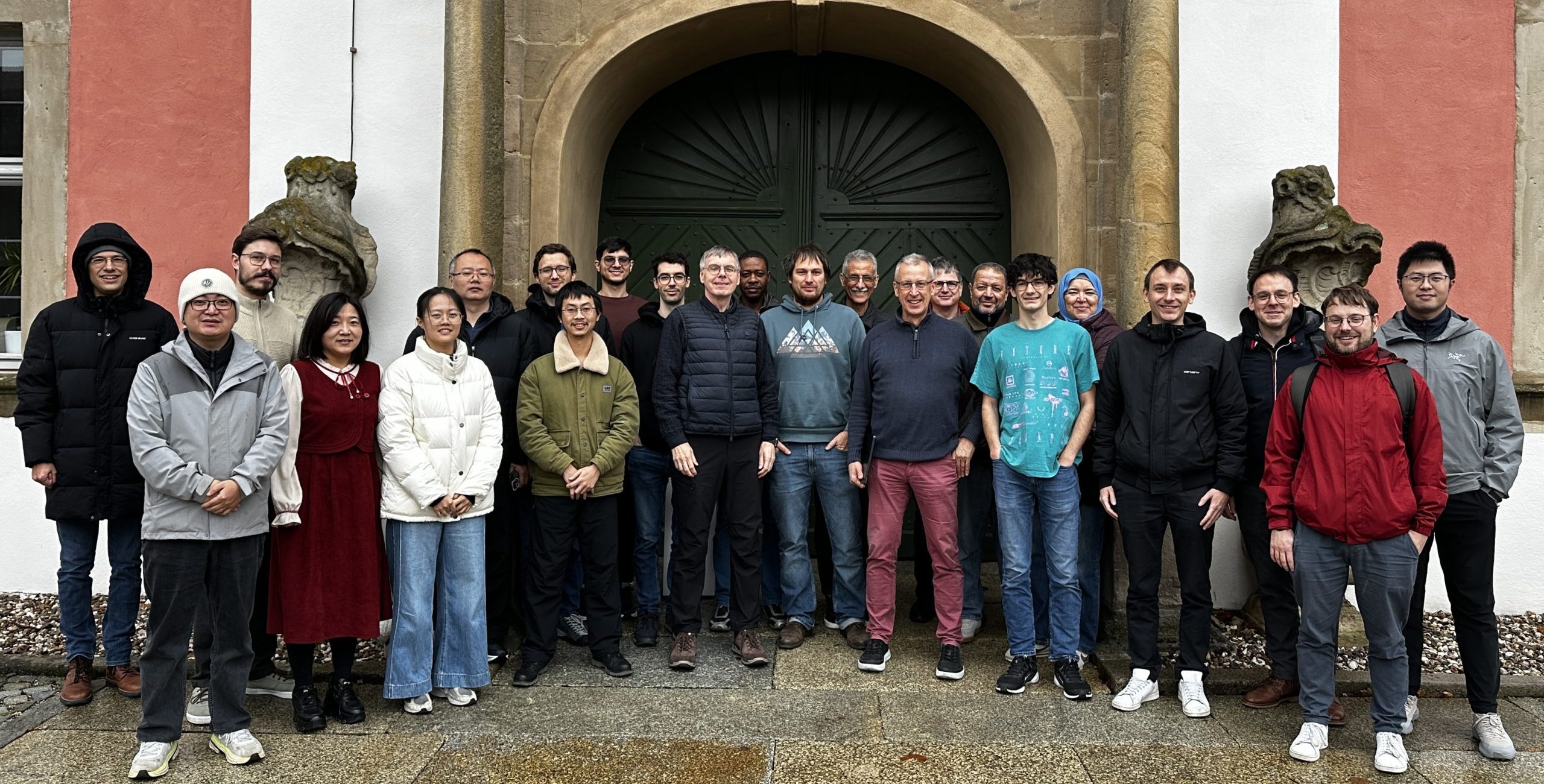
From mathematical foundations to industrial applications, a research retreat from 17 to 22 November 2026 brought learning systems, scientific exchange and time for reflection together at Speinshart Monastery.
Understanding how machines learn raises questions that reach deep into mathematics. How can we describe the behaviour of a learning system? How can data and mathematical models complement one another? And how can these approaches help address problems in science and industry?
These connections provided the focus for a November research retreat at the Speinshart Scientific Center for AI and SuperTech. Under the title “Machine Learning and Learning Systems – Modelling, PDEs, Numerics and Control”, the workshop brought together perspectives from mathematical research, applied science and industry. Its programme combined lectures with thematic working sessions, evening discussions and opportunities to experience the monastery and its surroundings.
Mathematical foundations for learning systems
The scientific programme opened on Wednesday, 18 November, with Enrique Zuazua’s lecture “Machine Learning and Learning Systems”. The opening contribution introduced the relationship between learning systems and mathematical understanding that ran through the week.
Giovanni Fantuzzi followed with “Perspectives in data-driven analysis of nonlinear dynamics”. His contribution connected the study of evolving, complex systems with approaches that draw on data. Alongside the workshop’s wider emphasis on modelling, partial differential equations, numerical methods and control, this established a broad mathematical context for the days ahead.
On Thursday, Yaoyu Zhang addressed “Neural Network Architecture Shapes Training Dynamics: Symmetry, Structural Invariant Manifolds, and Condensation”. The lecture addressed a fundamental relationship: how the structure of a neural network shapes the way it learns.
Together, these contributions connected questions about the behaviour of learning systems with the mathematical tools used to investigate them. For a retreat spanning both theory and applications, this provided a shared point of reference: understanding the systems being developed is an essential part of deciding how to use them.
Connecting research with industrial practice
Two industry lectures brought practical applications into this mathematical setting.
On Thursday, Christopher Straub of Fraunhofer IISB presented “Scientific Machine Learning for Industrial Simulation and Optimization”. The contribution connected the workshop’s research themes with simulation and optimisation in an industrial context, giving these applications a clear place alongside the foundational lectures.
This connection is central to the idea of scientific machine learning: bringing learning methods into conversation with models and knowledge from science and engineering. Within the workshop, the industrial perspective added a practical counterpart to questions about modelling, dynamics and the mathematical structure of learning.
Friday’s programme continued this exchange with “Explainable AI”, presented by Dominik Penk and Dominik Riedelbauch of Schaeffler Technologies. Their contribution introduced another important dimension: understanding how an AI system arrives at its outputs and making its behaviour more accessible to the people working with it.
Placing industrial simulation and explainability within the same programme gave participants opportunities to consider different requirements for useful AI. The relationship between mathematical understanding and practical use ran through both contributions, connecting the retreat’s theoretical interests with questions arising in applied work.
Thematic sessions shaped by early career researchers
A distinctive feature of the workshop was the involvement of early career researchers in co-organising the afternoon thematic sessions. This gave them an active role in shaping the scientific exchange and complemented the morning lecture programme with dedicated time for work around shared topics.
Three themes structured these afternoons.
On Wednesday, “Hybrid data-driven modelling”, coordinated by Daniel Fernández Martínez and Daniel López Montero, provided a focus for considering how different approaches to modelling can work together. The theme connected naturally with the morning’s attention to learning systems and nonlinear dynamics, extending the day’s scientific focus into a collaborative session.
Thursday’s session on “Data-driven fluid mixing”, coordinated by K. Kinra and Ziqian Li, brought a specific application area into view. Within the wider scope of the workshop, fluid mixing offered a meeting point for questions about physical processes, mathematical models, computation and learning from data.
On Friday, “Generative AI”, coordinated by Yaoyu Zhang and Zhonghua Liao, broadened the afternoon programme to another area of machine learning. Its inclusion alongside hybrid modelling and fluid mixing gave the thematic sessions a range extending from the construction of models to particular physical applications and generative approaches.
Each two-hour afternoon session allowed time to develop questions, compare perspectives and explore connections around a common subject. The invitation to relate individual contributions to the day’s theme also helped give the sessions a shared direction.
Mathematics beyond the lecture room
The programme also made space for broader perspectives on mathematics and AI through two film evenings.
On the arrival evening, Tuesday, 17 November, “There’s never been a better time to go into math” offered an introduction to the week beyond the formal lecture format. Thursday’s film evening featured Terence Tao’s ICM 2026 contribution, “Mathematics in the age of AI”.
These screenings added another way to engage with the workshop’s subject. Alongside specialised research topics, they placed broader questions about mathematics and its relationship with AI within the shared programme.
Wednesday and Friday evenings were reserved for open discussion, allowing the exchange to continue after dinner. This gave the retreat a rhythm in which formal contributions and informal conversation could complement one another throughout the day.
Time to think and a place to meet
The setting at Speinshart was an integral part of the retreat format. The programme combined focused scientific sessions with an extended midday break, shared meals and time outside the lecture room.
The monastery lounge was available for gatherings organised by the participants themselves. With space to meet over food and drinks, it offered an informal setting for continuing a conversation, returning to a question from a lecture or getting to know colleagues beyond their presentations.
On Friday, a guided tour with Dr Adrian Roßner brought Speinshart itself into the programme. It gave participants an opportunity to encounter the place hosting their research week and to connect their stay with the monastery’s historical setting.
Saturday afternoon was set aside for free time and hiking, adding an opportunity to step outside and explore the surroundings. Together with the breaks and informal evenings, this reflected a deliberate balance between concentrated work and time to pause.
That balance is closely connected to the purpose of the Speinshart Scientific Center. A retreat creates the opportunity to stay with a question over several days and to encounter the same colleagues in different settings. A discussion can begin in a lecture, continue over a meal and return in a more focused working session. The monastery provides a setting in which that continuity is possible.
Bringing the week together
Saturday’s scientific programme turned explicitly towards “Synergies and New Directions”. After the lectures and thematic sessions of the preceding days, the morning provided a dedicated opportunity to consider connections across the workshop’s subjects.
The final evening was reserved for “Conclusions, Takeaways and Next Steps”, giving reflection and future perspectives their own place in the programme before departure on Sunday, 22 November.
Across the week, mathematical foundations met industrial applications, while researchers at different career stages helped shape the exchange. For Speinshart, this combination reflects the purpose of a research retreat: sustained attention to demanding questions, conversations across areas of expertise and time together that extends beyond individual sessions.
We warmly thank all speakers, session coordinators, organisers and participants for contributing to this research week at Speinshart. We look forward to welcoming you back for further conversations, new questions and continued exchange.

Join the conversation