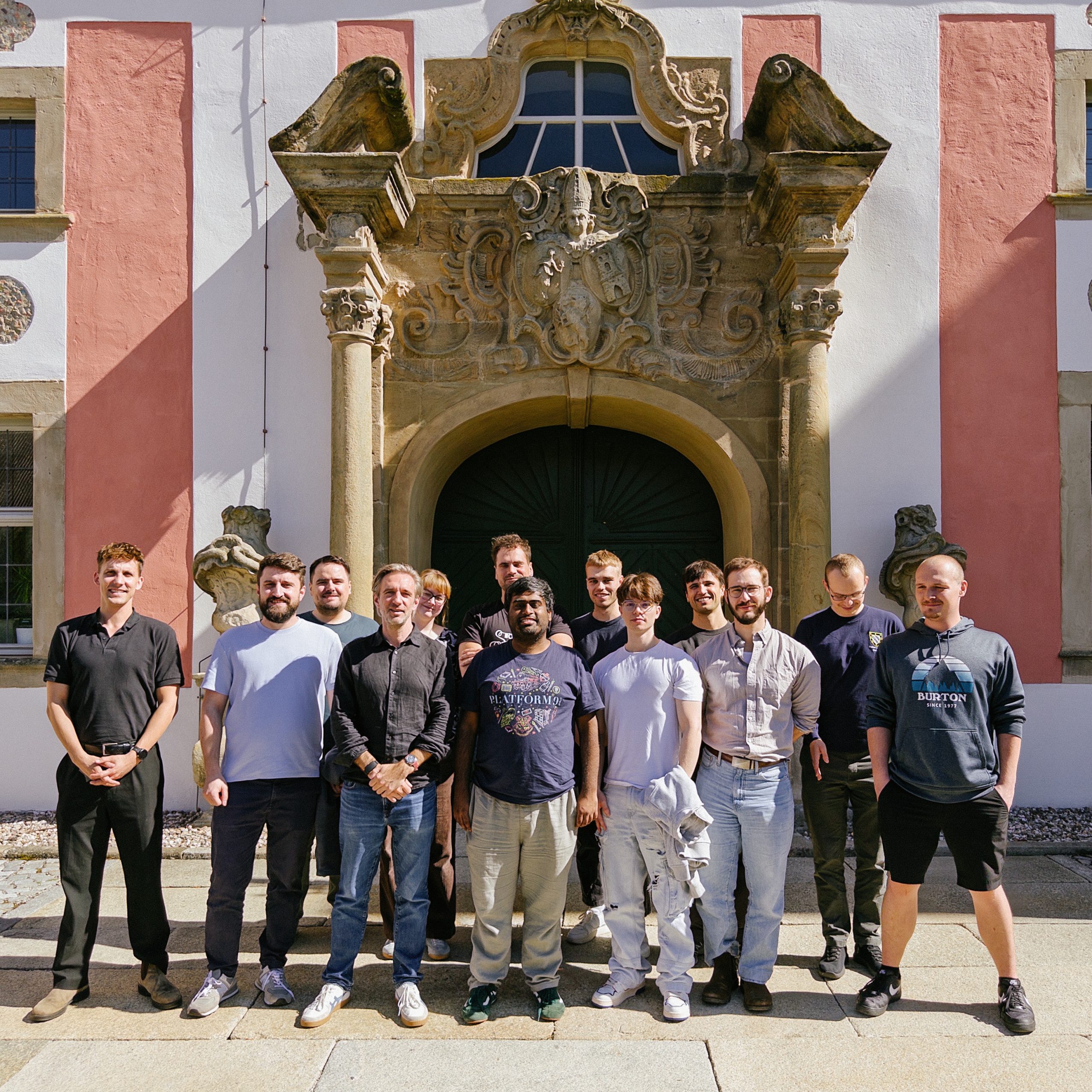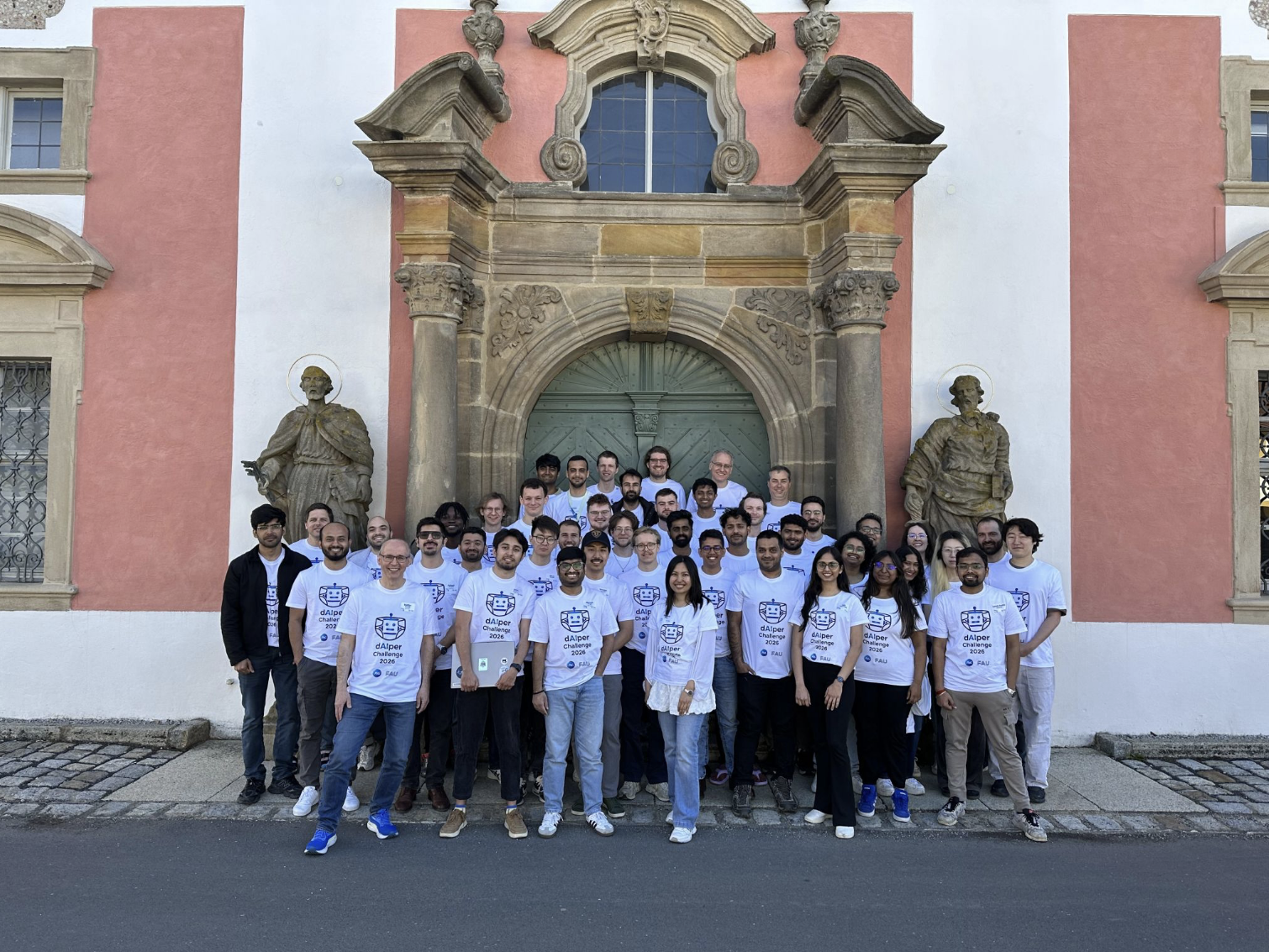
From April 24 to 26, 2026, the Speinshart Scientific Center for AI and SuperTech became the stage for an extraordinary experiment in innovation: the dAIper Hackathon 2026. Jointly organized by Friedrich-Alexander-Universität Erlangen-Nürnberg (FAU) and Procter & Gamble (P&G), the event brought together some of the brightest minds in computer vision and artificial intelligence to tackle real-world challenges from the consumer goods industry. And yes: This all happened in a monastery.
It’s not every day you solve Computer Vision problems in a monastery.
Johannes Gerstenauer
From Research Collaboration to Hackathon Format
The hackathon builds on a long-standing collaboration between FAU and P&G. Over the past years, their joint work has focused on applying computer vision and AI to complex problems in baby care products – particularly diapers. What initially seemed like a niche application quickly revealed itself to be a rich and challenging problem space. Questions around material properties, product components, and visual variability proved difficult to solve using a single approach. Classical computer vision methods offer transparency and control, while modern deep learning and foundation models promise rapid progress – but often struggle with fine details or generalization. The hackathon format was chosen deliberately: a fast-paced, collaborative environment to explore multiple approaches in parallel and identify what works best.
A Unique Setting for Focus and Creativity
The Speinshart Monastery provided more than just a scenic backdrop. Its secluded and focused environment played a key role in fostering creativity, collaboration, and deep work. Participants spent three intense days living, working, and exchanging ideas in close proximity far from everyday distractions.
Working on real-world computer vision challenges in such a unique setting pushed us to think fast, iterate faster, and make ideas actually work under pressure.
Shubhasmita Roy
Tackling Real-World Challenges
At the heart of the hackathon were real-world computer vision tasks derived from industrial applications. Teams worked on problems such as:
– Extracting features from diaper imagery
– Segmenting complex material structures
– Handling noisy, imperfect, and high-resolution data
– Ensuring robustness across different product variants
One particularly challenging task involved removing artwork from product images to isolate structural features.
Interestingly, not all solutions relied on the latest AI models. In some cases, classical approaches proved more effective. This highlighted one of the key learnings of the hackathon: there is no one-size-fits-all solution – and combining approaches is often the most powerful strategy.
Collaboration Across Disciplines
The hackathon brought together around 30 carefully selected master’s and PhD students, supported by researchers and industry experts from both FAU and P&G. The diversity of backgrounds, ranging from classical computer vision to deep learning and multimodal AI, enabled a rich exchange of ideas and perspectives.
The conversations, exchanges of ideas, and perspectives I encountered were just as valuable as the hackathon itself.
Arpitha Algole
Beyond the technical challenges, the event became a platform for networking, learning, and building lasting connections between academia and industry.
More Than Just a Competition
While the hackathon produced impressive technical results, its true impact goes beyond rankings and awards.
Participants repeatedly emphasized the value of:
– Rapid prototyping and experimentation
– Learning from failure and iteration
– Interdisciplinary collaboration
– Exposure to real industrial challenges
The event also demonstrated how powerful hackathons can be as a tool for exploring complex solution spaces, especially when multiple valid approaches exist.
Looking Ahead
The dAIper Hackathon 2026 showcased what is possible when academia and industry come together in the right environment, with the right people, and the right mindset.
It not only generated promising technical insights but also strengthened the collaboration between FAU and P&G and contributed to building the next generation of AI talent.