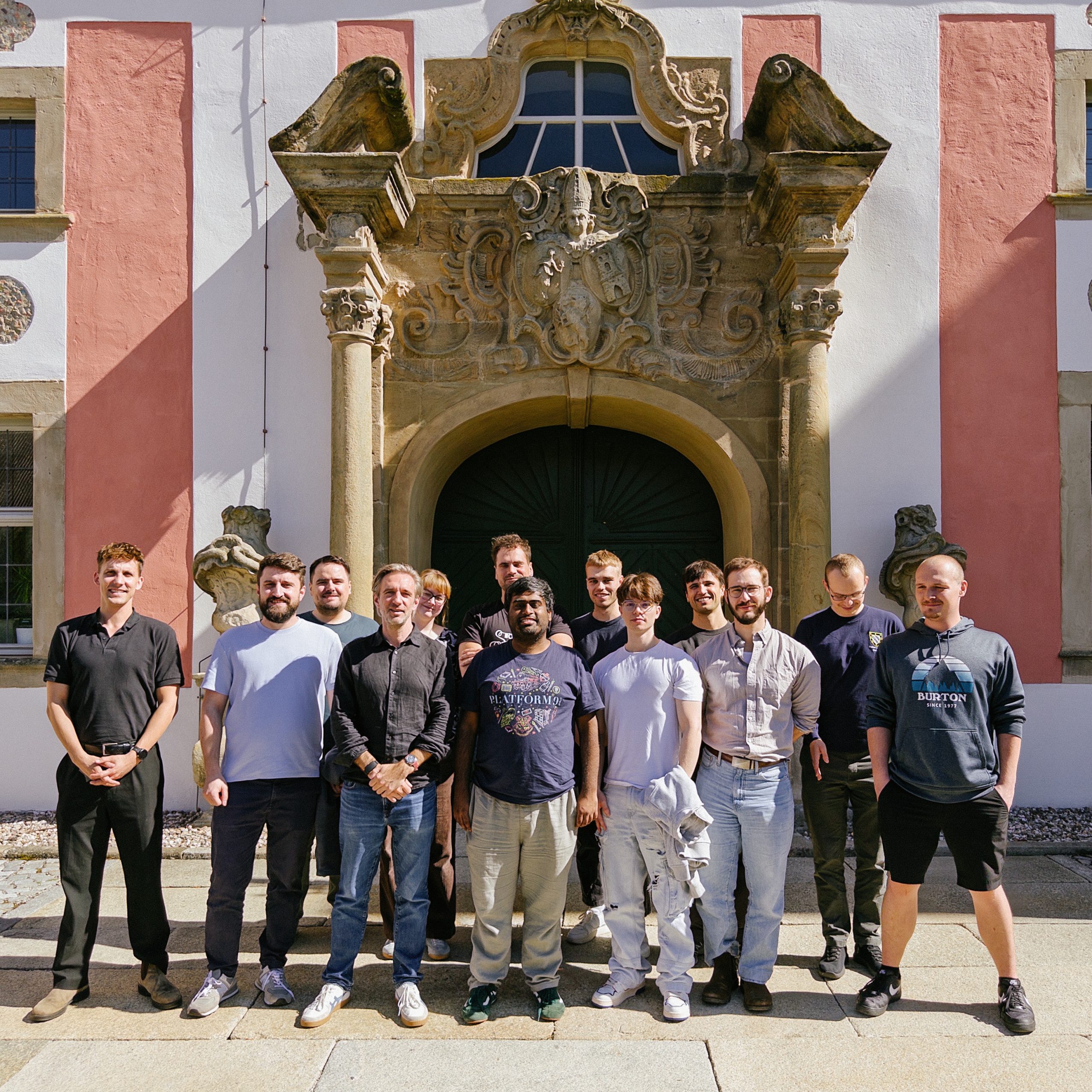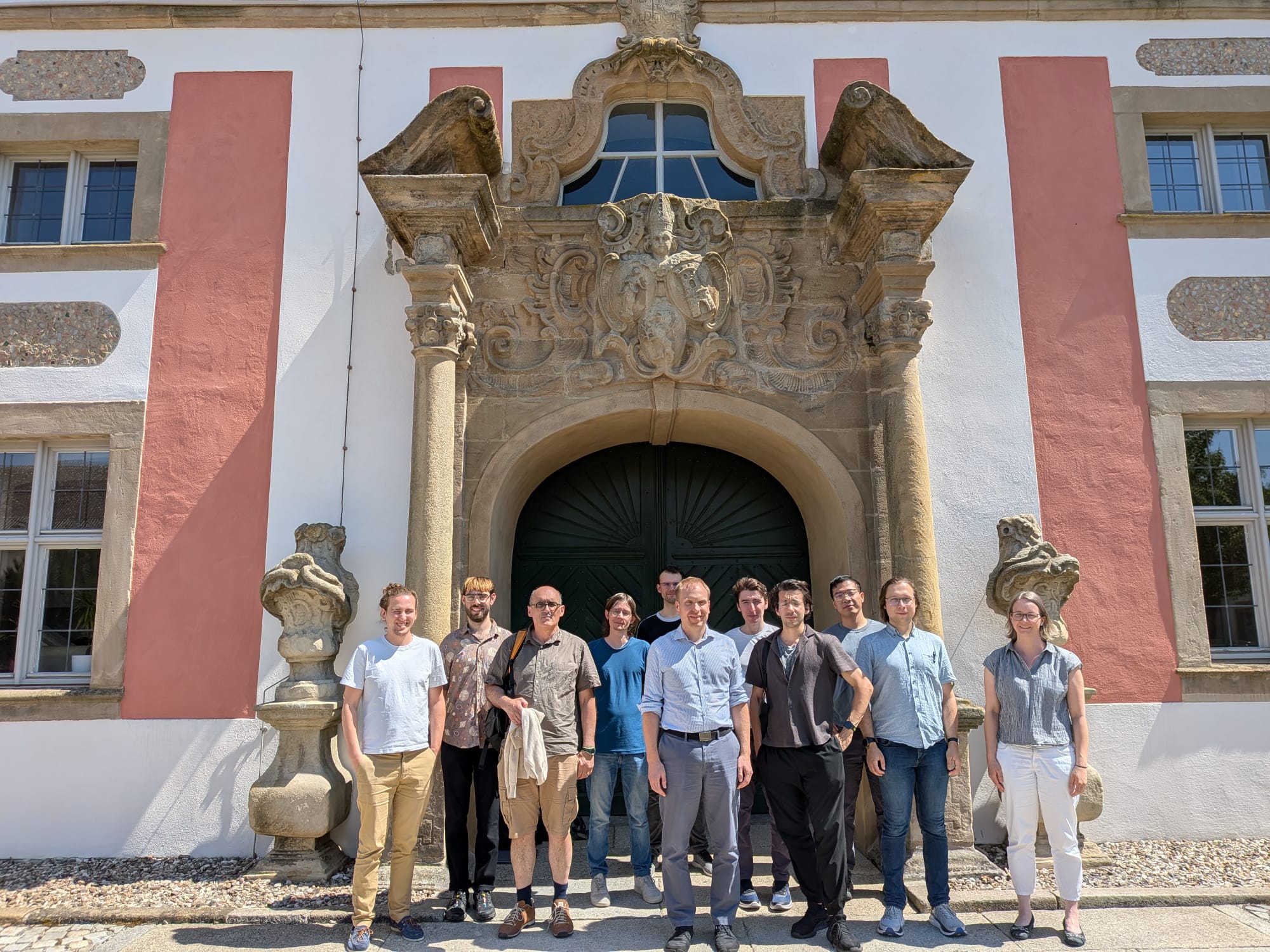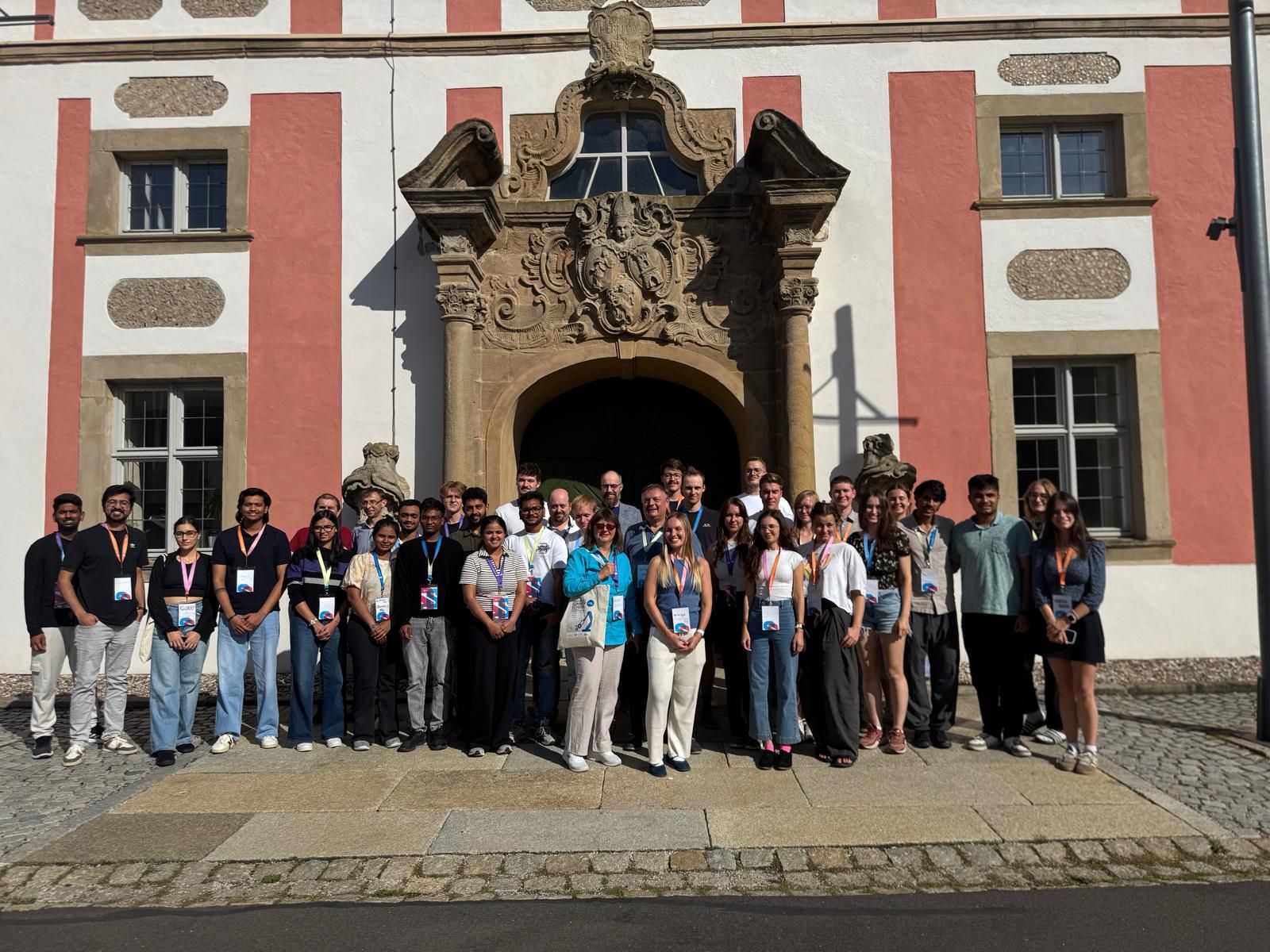
For five intensive days, the Speinshart Scientific Center for AI and SuperTech became a meeting place for young talent, researchers, and experts from Bavaria and Czechia. The AI Summer School 2026 brought together 30 students from nine institutions for a week combining cutting-edge AI topics, hands-on experience, an industrial challenge, and cross-border exchange.
Hosted in the unique setting of Kloster Speinshart, the Summer School was designed to offer much more than a traditional series of lectures. Participants were invited to learn, experiment, collaborate under real-world conditions, and develop their ideas together with students they had only just met.
From first encounters to first experiments
The Summer School opened with welcoming remarks by Prof. Günter Leugering, Scientific Director of the Speinshart Scientific Center for AI and SuperTech, and Radka Bonacková, Director of BTHA. Together with the organizers, Prof. Jan Pospíšil and the SSC team, they welcomed the participants to Speinshart and set the stage for the days ahead.
Before diving into the technical program, team-building activities gave the students an opportunity to get to know one another and to experience the special atmosphere of the monastery. The first academic impulse followed with an inspiring lecture by Dr. Marek Hruz on Computer Vision and Artificial Intelligence.
On the second day, the focus shifted directly to practical work. Dr. Marek Hruz and Dr. Petr Neduchal from the Faculty of Applied Sciences at the University of West Bohemia in Pilsen introduced the hackathon tasks and dataset. The teams began exploring different approaches, discussing possible solutions, and running their first experiments.
In the afternoon, Prof. Jan Čech from the Czech Technical University in Prague provided further inspiration with a lecture on Generative AI for Visual Data. Equipped with new ideas, the participants returned to their projects and continued refining their approaches.
Bringing AI into an industrial context
A central aim of the Summer School was to connect academic knowledge with practical challenges. The third day therefore took the participants beyond Speinshart and into an industrial environment.
Organized with the support of IHK Regensburg für Oberpfalz / Kelheim, the group visited Konplan s.r.o., part of the Krones Group, where presentations and discussions offered valuable insights into the company’s activities and the practical application of technology in industry.
The visit was followed by a change of perspective: after lunch, a city rally organized by Tandem – Koordinierungszentrum Deutsch-Tschechischer Jugendaustausch led the participants through Pilsen. Even the rainy weather could not dampen the group’s enthusiasm. The excursion added another dimension to the week, allowing participants to discover the city together and further strengthen the connections within the group.
Robotics, Industrial AI – and music at the monastery
Back in Speinshart, Day 4 began with a keynote by Prof. Markus Rickert from the University of Bamberg on Robotics and Industrial AI. His presentation complemented the practical challenge of the Summer School by placing the students’ work in the broader context of intelligent industrial systems.
The teams then continued their hackathon projects under the guidance of Dr. Petr Neduchal and Prof. Kamil Ekšteinfrom the University of West Bohemia. By this point, several groups were already able to present first partial solutions and discuss their progress.
Prof. Ekštein had also provided the dataset underlying the hackathon challenge – but his contribution to the week went beyond AI. Music became part of the evenings at Kloster Speinshart as well, demonstrating that the monastery’s remarkable acoustics are equally suited to informal cultural moments and scientific exchange.
A challenge with real-world consequences
On the final day, the hackathon entered its decisive phase. From early morning until lunchtime, the teams submitted their solutions, reviewed the evaluation results, and made final improvements. Each team had three submission attempts, with the best result counting towards the final ranking.
The evaluation reflected the complexity of a genuine industrial problem. Solutions were assessed not only according to the number of classification errors, but also according to execution time and the resulting financial impact.
This made the trade-offs particularly tangible. An incorrectly classified component may result in an entire production line being stopped and a technician being called – an expensive interruption. At the same time, even a highly accurate solution can become costly if it slows down production significantly.
The challenge was therefore not simply to achieve the highest possible accuracy. Participants had to find a balance between accuracy, speed, and economic impact – precisely the kind of multidimensional problem that characterizes the use of AI in real industrial environments.
More than a week of technical training
From the perspective of the Speinshart Scientific Center, the value of such a Summer School extends well beyond the technical content.
The students encountered many of the conditions that characterize real scientific and professional work: absorbing new material quickly, working under time pressure, dealing with limited resources, testing ideas that may or may not work, and collaborating with people with different backgrounds, strengths, and approaches.
Over the course of only a few days, individual participants became teams. They learned not only from the lecturers and mentors, but also from one another – supporting each other, discussing competing ideas, solving problems together, and sharing both successful and unsuccessful experiments.
Perhaps the most meaningful indication of what had developed during the week came at the very end: students from Bavaria and Czechia saying goodbye with hugs, smiles, and even a few tears.
The AI Summer School 2026 was therefore not only about Computer Vision, Generative AI, Robotics, or industrial applications. It was also about creating opportunities for young people to grow professionally and personally, to build networks across borders, and to form new friendships.
For the Speinshart Scientific Center, this combination of excellent science, practical experience, interdisciplinary collaboration, and international exchange is at the heart of what a Summer School can achieve.
We would like to thank all lecturers, organizers, and, above all, the participating students for five inspiring days at Speinshart. We are already looking forward to the ideas and collaborations that may grow from the connections made during this week.
The most important thanks belong to our partners, the Bayerisch-Tschechische Hochschulagentur (BTHA) and the OTH Amberg/Weiden, and to the two main organizers Tatyana Ivanovska and Jan Posipíšil!