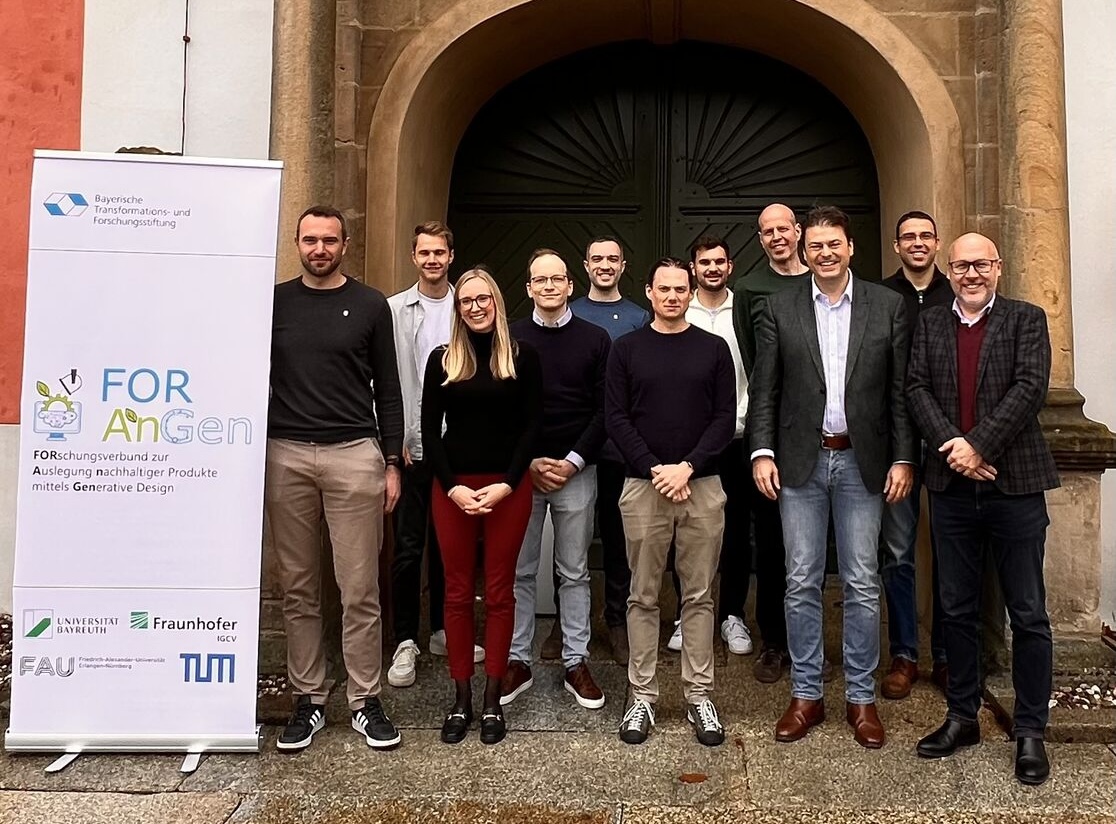
After two years of collaborative research, the Bavarian research consortium FORAnGen returned to the Speinshart Scientific Center for AI and SuperTech to reflect on its achievements, strengthen interdisciplinary cooperation, and set the course for the final phase of the project.
How can artificial intelligence and advanced engineering methods help create products that are not only more efficient, but also more sustainable? This question lies at the heart of FORAnGen, a Bavarian research consortium dedicated to advancing sustainable product development through Generative Design.
Bringing together leading research institutions and numerous industrial partners, the consortium explores how computational design methods can contribute to a more resource-efficient and resilient manufacturing industry.
Following an earlier retreat at Speinshart, representatives of the participating research institutions once again gathered at the Speinshart Scientific Center for AI and SuperTech to review their progress after two years of collaboration and discuss the strategic priorities for the project’s final phase.
Bridging the Gap Between Digital Design and Manufacturing
Generative Design is transforming the way engineers develop products. By combining sophisticated optimization algorithms, simulations, and AI-supported methods, it enables the automated exploration of numerous design alternatives based on predefined requirements.
However, designing a theoretically optimal component is only part of the challenge. Ensuring that it can be manufactured economically, performs reliably, and minimizes its environmental footprint is equally important.
This is precisely where FORAnGen comes in.
Coordinated by the University of Bayreuth, the consortium brings together researchers from the Fraunhofer Institute for Casting, Composite and Processing Technology IGCV, the Laboratory for Product Development and Lightweight Design at the Technical University of Munich, and the Institute of Manufacturing Technology at Friedrich-Alexander-Universität Erlangen-Nürnberg.
Together with more than 20 industrial partners, they are developing methods to integrate manufacturing constraints and sustainability assessments directly into the Generative Design process.
The research encompasses technologies such as casting, additive manufacturing, metal forming, and hybrid manufacturing approaches. By connecting digital optimization with real-world production requirements, the project aims to make sustainable design solutions more accessible and applicable in industrial practice.
The potential is already becoming visible: During a recent project evaluation, the consortium presented several demonstrators, including an optimized cast-aluminium engine support whose mass had been reduced by 21.1 percent to just 2.91 kilograms.
A Place for Reflection, Exchange, and New Perspectives
After two years of intensive research, the retreat at Speinshart provided an opportunity to look beyond individual work packages and consider the broader direction of the consortium.
The participants reflected on the progress achieved so far, exchanged perspectives across their respective areas of expertise, and aligned their next steps towards the completion of the project.
As during their previous visit, the unique setting of the Speinshart Scientific Center offered an environment particularly suited to these discussions.
Located within the historic Speinshart Monastery, the Center combines centuries of intellectual tradition with a forward-looking commitment to artificial intelligence and emerging technologies.
Away from the demands and distractions of everyday academic life, researchers have the opportunity to engage in concentrated discussions, develop new ideas, and strengthen the personal connections that make successful scientific collaboration possible.
The FORAnGen retreat once again demonstrated the value of bringing together different disciplines in an environment designed specifically for scientific exchange.
Looking Ahead: Turning Research into Impact
With the consortium now entering its final project phase, the focus increasingly shifts towards further validating the developed methods and demonstrating their potential for practical industrial applications.
The project’s ambitions extend beyond individual technological improvements. By integrating sustainability, manufacturability, and computational optimization into a more comprehensive approach to product development, FORAnGen seeks to contribute to the long-term transformation of industrial production.
For the Speinshart Scientific Center, hosting collaborations such as FORAnGen reflects an essential part of its mission: creating an environment in which scientific excellence, interdisciplinary dialogue, and technological innovation can come together to address real-world challenges.
We were delighted to welcome the FORAnGen researchers back to Speinshart and thank all participants for the inspiring exchange and their continued commitment to collaborative research.
Our appreciation also goes to the Bavarian Transformation and Research Foundation (Bayerische Transformations- und Forschungsstiftung), whose financial support makes this ambitious research collaboration possible.
We look forward to following FORAnGen’s progress as the consortium moves towards the completion of its research programme in 2027.



Join the conversation